
Fifty-Five Years and Zero Reversals
How the fiscal trap became self-reinforcing, and why conventional solutions keep failing

This article was created as part of The Boyd Institute's essay contest on America's debt and deficit. They asked for a solution. My entry argues that no fiscal solution closes the gap, because the gap is not fiscal.
To learn more about the Institute, or to submit your own article, click here.
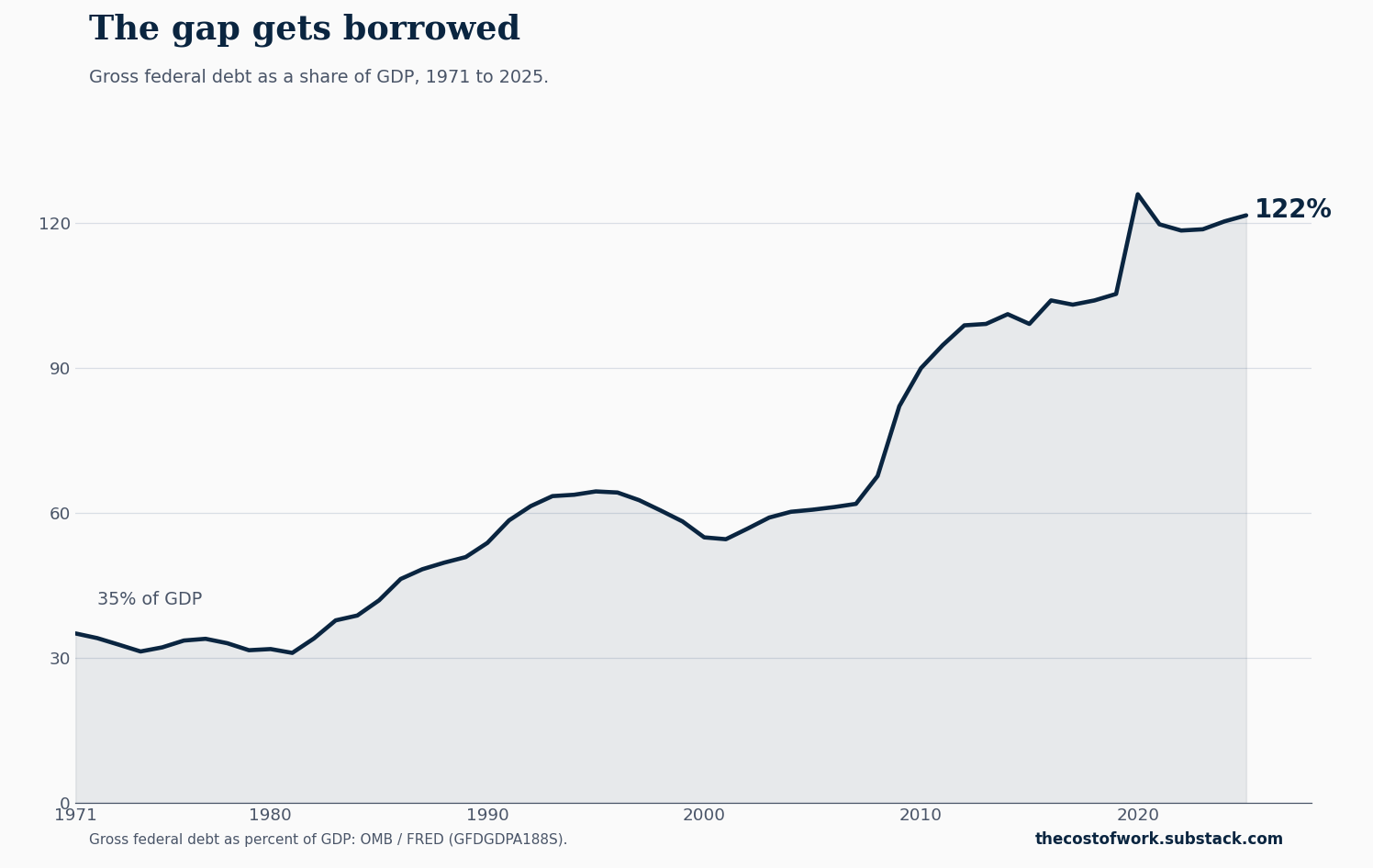
The United States government collects $5.2 trillion in revenue and spends $7 trillion. It borrows about $1.8 trillion each year to cover the difference. Total national debt has crossed $39 trillion. Interest payments on that debt now exceed the defense budget.
These numbers are familiar, and so is the fight over them. One side says we spend too much. The other says we tax too little. Both propose solutions within that frame: cut programs, raise rates, grow faster.
None of it has worked. Some approaches produced temporary results: a surplus here, a spending decline there. Each time, the underlying trajectory resumed. The fiscal trap is downstream of a structural divergence that no spending bill, tax reform or growth agenda has ever reversed.
The gap widened under every administration
Since 1971, nonfarm business productivity in the United States has risen 178 percent. Real hourly wages for production and nonsupervisory workers, the majority of the workforce, have risen ten percent.
Output per hour nearly tripled. The hourly paycheck barely moved.
This divergence did not begin under one party and reverse under the other. It widened under Nixon, Ford, Carter, Reagan, Bush, Clinton, Bush, Obama, Trump and Biden. Through deregulation and regulation. Through tax cuts and tax hikes. Through stimulus and austerity. No administration reversed it. No policy regime closed it.
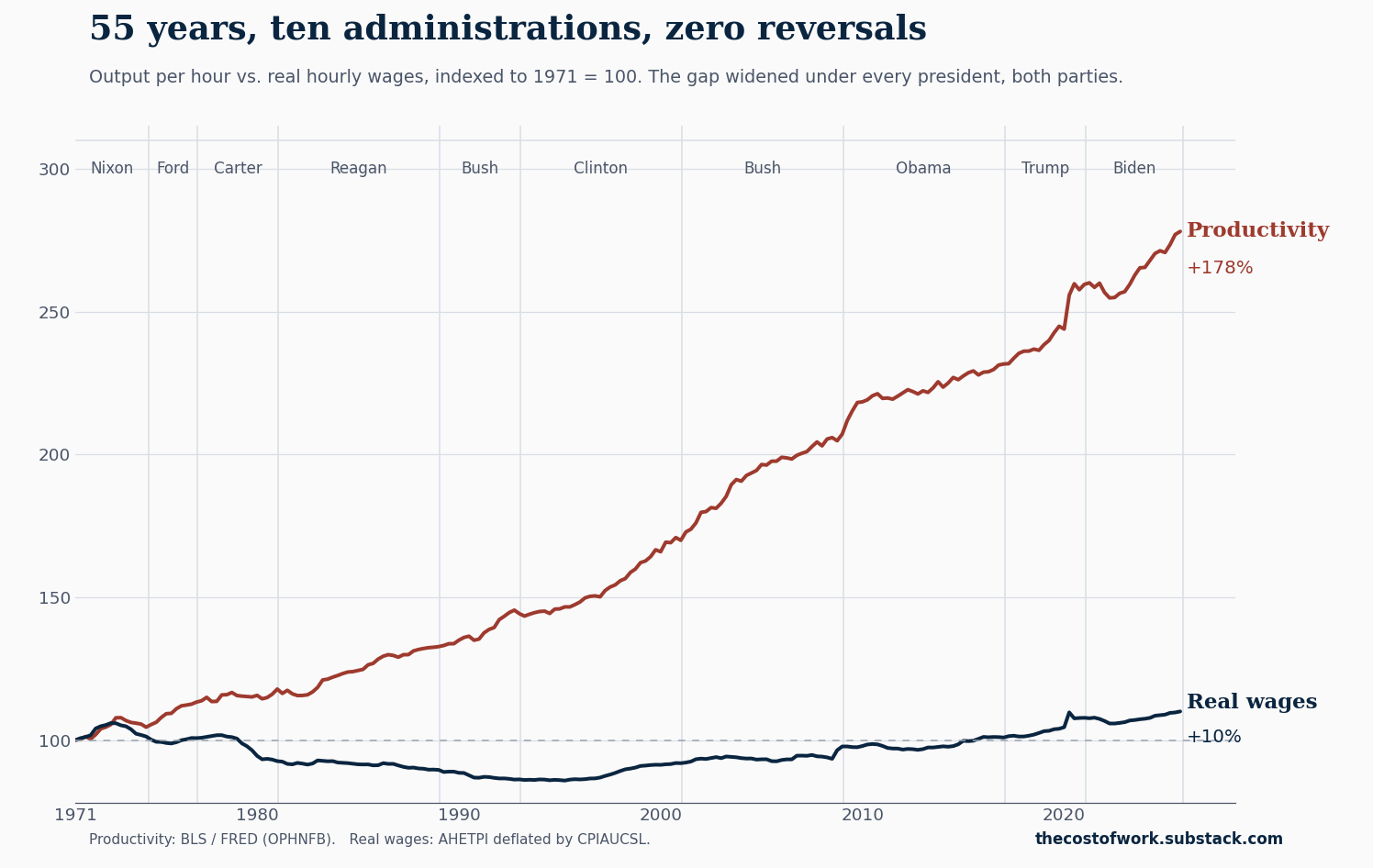
The productivity gains happened. The economy became far more efficient at producing goods and services. But the gains did not flow through to the workers who produced them. They reached asset prices, equities and real estate, while the paychecks that fund consumer spending and tax revenue barely moved.
The fiscal trap is a patching operation
Federal spending grows for reasons that have little to do with budget discipline. An aging population moves onto Social Security and Medicare. Healthcare costs rise faster than the economy. Interest compounds on debt already issued. CBO’s latest projections name Social Security, Medicare and net interest as the drivers of the coming decade’s spending growth, while discretionary spending falls as a share of the economy. Demographics and prices set that path.
The wage divergence works on the other side of the ledger. The federal revenue base rests on payroll and income taxes levied on wages. When output per hour nearly triples while the wages those taxes fall on barely move, the revenue base grows far slower than the obligations it funds. The gap is structural, and it sits on the revenue side. The government borrows to close it.
Social Security shows the mechanism in miniature. It is funded by payroll taxes on wages. Demographics drive its costs upward on a fixed schedule. Wage stagnation starves it of the revenue that would have cushioned the demographic wave. The shortfall runs deeper because the system was built for wage growth that stopped arriving.
Healthcare shows where the missing raise went. Spending per capita rose from about 100 hours of labor in 1970 to nearly 500 today. Total compensation grew faster than wages, but much of the difference went to health premiums rather than take-home pay. The compensation line rose. Workers never saw it.
Interest is the patch feeding on itself. Annual interest on the national debt now exceeds $1 trillion, more than the defense budget, and has close to doubled in three years. Some of that jump is higher rates rather than new borrowing, but the direction is fixed: interest compounds on the debt already owed, and more than half of every borrowed dollar now covers the cost of past borrowing. The patch has become self-reinforcing.
Why conventional solutions fail
Three approaches dominate the fiscal debate. Each one has been tried. None has closed the gap.
Cut spending. The two administrations most associated with spending restraint both achieved it relative to the economy. Reagan brought outlays down about a point of GDP. Clinton brought them down nearly four. The productivity-wage divergence widened through both. Restraint on the spending side does not reach the divergence on the revenue side. Cutting the patch does not close what created it. It moves the shortfall from the federal balance sheet to the household balance sheet, where it shows up as medical debt, deferred retirement and skipped meals.
Raise taxes. Tax increases can close the annual deficit. They cannot close the structural gap. The Clinton years produced the strongest fiscal position in recent memory: surpluses and a falling debt-to-GDP ratio. The productivity-wage divergence widened through all of it. The surplus ended because of what came after: the 2001 tax cuts, a recession, two wars and the 2008 crisis. A budget can be balanced and then unbalanced by later choices while the divergence underneath it never moves. The revenue base depends on payroll and income taxes levied on wages, and when wages rise ten percent over half a century, raising rates on that base yields less each time and never reaches why the base stagnated.
Grow faster. This is the most intuitive answer. The late 1990s were the best-case scenario: a technology-driven productivity surge, low unemployment, rising wages, budget surpluses. If growth alone could close the gap, that was the moment. The gap widened anyway. Productivity already rose 178 percent over the full period. The economy did grow dramatically faster. It did not reach wages. More growth within the same system produces the same distribution: gains flow to assets, costs flow to workers, the government borrows to cover the difference. Growing your way out of a fiscal trap requires it to reach the revenue base. Under current conditions, it does not.
Each approach treats the fiscal trap as a budgetary problem with a budgetary solution. The pattern outlasted every correction. The trap is in the divergence underneath the budget: the half-century separation between what the economy produces and what workers are paid.
What every plan takes as fixed
One variable stays constant across every fiscal proposal, regardless of political origin. It is embedded so deeply in the policy landscape that it rarely comes up in the debate at all: the monetary system.
The productivity-wage divergence opened at a specific break. In 1971, the United States suspended the convertibility of the dollar to gold, completing the transition from a commodity-constrained monetary system to a purely discretionary one. It is among the most significant changes to the global financial system in the postwar era. The divergence begins there and widens continuously, through every administration and every policy regime that followed.
The same pattern appears across the United States, the United Kingdom, Canada, Australia and New Zealand. Housing is the clearest case: affordability has collapsed by similar magnitudes in all five, across very different housing policies, tax codes and labor regimes. When an outcome holds across such different domestic policy environments, the cause is unlikely to be any single country’s policy mix. It is more likely something they share.
They share more than a monetary system. Common language, integrated capital markets, financialized housing and synchronized cycles are all candidates. But the monetary system is the shared variable that changed at the exact point the divergence began, in all of them at once. That is why it belongs at the front of the examination, not assumed away. Ruling the other shared factors in or out is part of the work, not a step to skip.
The escape
The fiscal trap cannot be solved from inside it.
Every plan that takes the monetary system as fixed and adjusts spending, taxes or growth within that frame is shuffling pieces inside a structure that produces the same divergence regardless of the arrangement. Fifty-five years of data, ten administrations and zero reversals.
If the divergence had appeared before 1971 under the prior monetary system, a shared monetary cause would be in doubt. It did not; the seam is 1971 in the data. If any country on the same post-1971 system had reconnected wages to productivity through domestic policy alone, the monetary explanation would weaken. None has. If a future administration closes the divergence without touching the monetary system, the thesis fails outright. That test is still open, and fifty-five years have not met it.
The escape requires putting the monetary system on the table as the primary variable under examination.
While that examination proceeds, the tax system does not have to keep making things worse. The federal revenue base depends on payroll and income taxes, both levied on wages that stopped growing fifty years ago. A tax system built on a stagnant variable will run deficits regardless of the rate. Shifting the base toward consumption, business cash flow and accumulated wealth would not close the divergence. It cannot. But it would stop the tax code from compounding a problem it did not create.
The debate has run on downstream questions for decades: spend more or less, tax more or less, grow faster or slower. Underneath them is one question: why does a system that produces 178 percent more output deliver only ten percent more in real wages, and what would it take to change that?
Until that variable is examined, every fiscal plan is a new arrangement of furniture in a building with a cracked foundation. The furniture can be rearranged endlessly. The crack remains.
A detailed proposal for shifting the federal tax base away from wages is available here: Built for a Paycheck That Stopped Growing, offered as an improvement rather than a solution.
Ha!
At this point it is in the DNA.